By Kaleb Hines
October 21, 2026
Warm weather brings outdoor dining, gardening, and afternoon leisure, but it also brings buzzing, stinging insects that can quickly turn a peaceful day into a stressful situation. When a stinging pest hovers around your patio or builds a nest under your eaves, your immediate reaction might be to retreat indoors. However, knowing exactly what kind of insect you are dealing with is crucial for making smart decisions regarding safety, environmental preservation, and removal. Bees, wasps, and hornets are frequently confused with one another because they share similar yellow, brown, and black color schemes, and they all possess the ability to sting. Despite these superficial similarities, these three groups of insects belong to different families or subcategories, exhibit distinct physical traits, maintain vastly different diets, and build unique structures to house their colonies.
Understanding how to tell them apart helps you respond appropriately with pest control services. For instance, bees are essential pollinators that generally avoid conflict, while paper wasps and yellowjackets can become highly aggressive when defending their turf. Identifying the insect correctly allows you to determine whether you can simply leave the creature alone or if it is time to contact professional pest control services to evaluate a potential hazard. By paying attention to body shape, hairiness, color distribution, nesting locations, and foraging behavior, you can easily tell whether you are looking at a helpful bee, a predatory wasp, or an intimidating hornet.
Identifying Key Physical Characteristics
The most reliable way to distinguish between these stinging insects is by carefully observing their physical structure. Bees are easily recognized by their hairiness. Their bodies are covered in branched hairs that capture pollen as they visit flowers. This hair gives them a soft, rounded, and distinctly fuzzy appearance. Honeybees are relatively small and feature muted golden-brown and black stripes, whereas bumblebees are much larger and stockier. According to PestWorld.org, bumblebees are between ¼ and one inch in size, have black and yellow markings, and an overall fuzzy appearance.
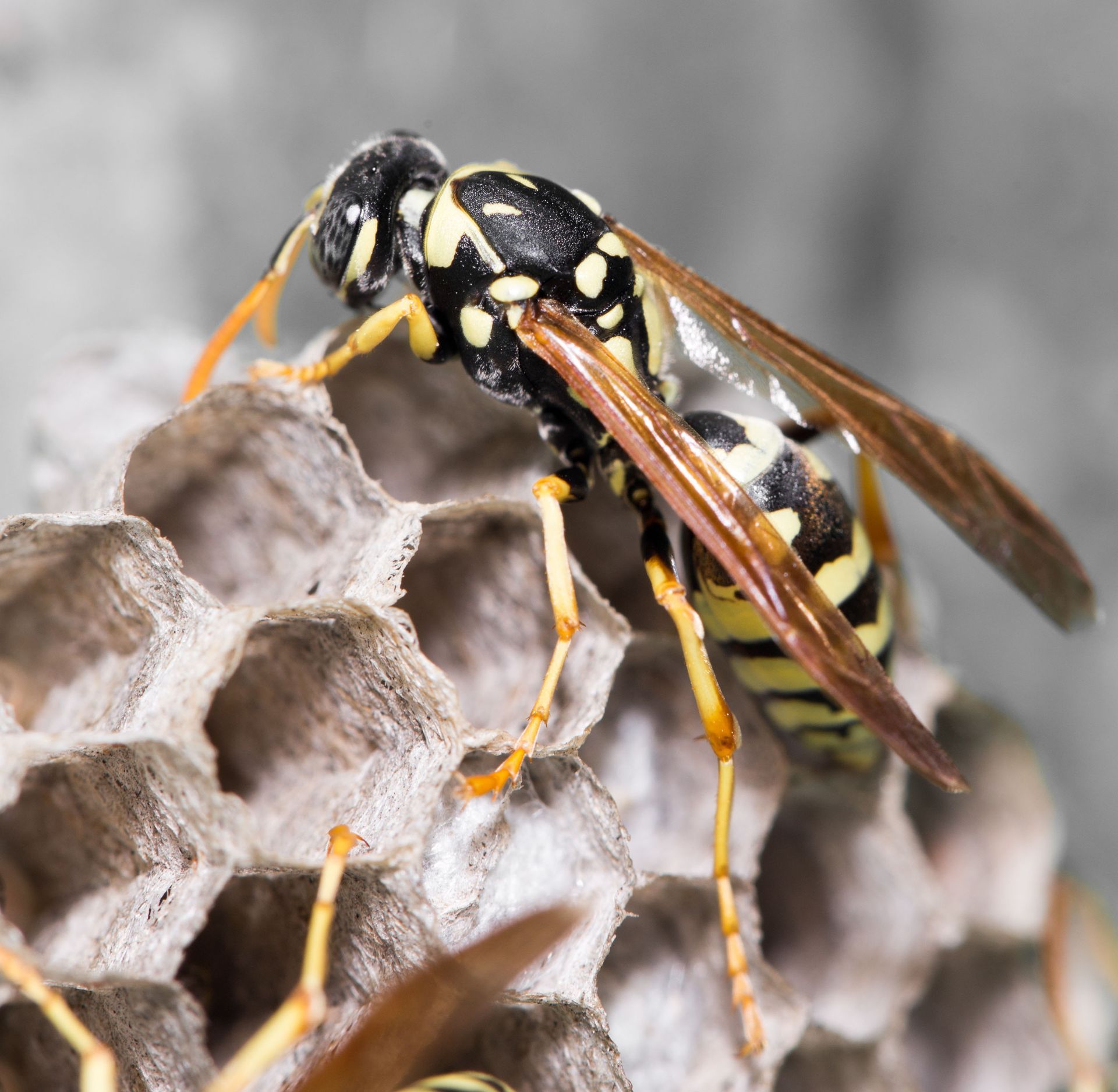
Wasps and hornets, by contrast, present a sleek, shiny, and hairless look. They have smooth exoskeletons with bright, highly defined color patterns. A key anatomical feature of wasps is their pinched waist, known as a petiole, which creates a sharp separation between the thorax and abdomen. This narrow waist gives wasps an elongated, slender build with long, dangling legs that hang visibly when they fly.
Hornets are technically a specific subset of social wasps, but their sheer size sets them apart. Hornets are significantly larger and bulkier than standard paper wasps or yellowjackets, often reaching lengths of over an inch to nearly two inches. While wasps usually display vivid yellow and black patterns, European hornets feature reddish-brown markings mixed with yellow, and bald-faced hornets display striking black and white patterns. If you notice large, thick-bodied insects gathering near your attic or trees, reaching out to reliable pest control services can help confirm their identity before anyone gets stung.
Identifying Distinct Nesting Habits
Observing where and how these insects build their homes provides another major clue. Bees construct their nests using wax that they secrete from their own bodies. Honeybees build intricate, multi-layered wax honeycombs inside enclosed spaces like hollow trees, wall cavities, or commercial wooden hives provided by beekeepers. Bumblebees, on the other hand, build small, unstructured nests in underground cavities, abandoned rodent burrows, or under dense compost heaps and thick grass.
Wasps and hornets construct their nests from a paper-like material created by chewing wood fiber mixed with saliva. Despite using similar building materials, different species create very distinct structural designs. Common paper wasps build open, umbrella-shaped paper combs that hang from porch roofs, door frames, or outdoor overhangs. These nests leave the individual cells completely exposed from below.
Hornets and yellowjackets build enclosed paper nests. Yellowjackets frequently nest underground in abandoned animal burrows, inside wall voids, or under landscaping timber, concealing their nests entirely except for a small entry hole. True hornets build massive, teardrop-shaped paper aerial nests that are fully enclosed by a protective outer paper casing. These large structures are typically suspended high in tree branches, under elevated roof peaks, or inside dark barn rafters. Because removing an enclosed hornet nest or an underground yellowjacket colony poses a high risk of multiple stings, homeowner attempts at DIY removal are strongly discouraged, making professional pest control services the safest option.
Identifying Behavioral Patterns and Diets
Dietary habits dictate how these insects behave around humans. Bees are strictly vegetarian, feeding exclusively on floral nectar for energy and pollen for protein. Because their survival depends on flowers, you will usually find bees hovering peacefully around gardens, orchards, and flowering clover. They are non-aggressive by nature and will only sting if stepped on, squeezed, or if their hive is directly threatened. Honeybees possess barbed stingers that get stuck in mammalian skin, causing the bee to die after stinging once.
Wasps and hornets are omnivorous predators. While adult wasps do consume nectar and sweet plant juices for energy, they actively hunt other insects, spiders, caterpillars, and flies to feed their developing larvae. This predatory nature makes them far more territorial, active, and curious around human activity. Wasps and hornets are frequently attracted to human food, especially sweet beverages, ripe fruit, outdoor grills, and trash cans.
Unlike bees, wasps and hornets possess smooth stingers that do not detach after a sting. This allows a single individual to sting repeatedly without dying, injecting venom each time. Their defensive instincts trigger rapidly if someone approaches their nesting area or swat frantically at them. If aggressively foraging pests interrupt your outdoor meals every weekend, scheduling an inspection with local pest control services can help identify nearby food attractants and nesting sites.
Identifying the Level of Threat
Assessing the level of danger depends entirely on which insect is present on your property. Bees generally pose a low threat to humans unless someone in your household suffers from a severe insect sting allergy. Because honeybees and bumblebees play a vital role in food production and ecosystem health, live relocation by a local beekeeper is always the preferred approach when a bee nest is located too close to human activity.
Wasps and hornets present a higher level of threat due to their multiple-sting capability, defensive behavior, and tendency to build nests near entryways, outdoor patios, and play areas. Yellowjackets are particularly treacherous in the late summer and autumn when their food sources diminish, making them extremely aggressive toward humans sharing outdoor space. Hornets possess potent venom that causes significant pain and swelling, and their large colonies will aggressively defend their nests in large swarms if disturbed.
When dealing with a high-threat species, attempting to spray nests with store-bought aerosols often agitates the colony, leading to dangerous sting incidents. Enlisting experienced pest control services ensures that technicians use proper protective gear, specialized equipment, and targeted treatments to manage the situation safely.
Identifying Safe Property Management Solutions
Managing stinging insects safely requires a balanced approach between prevention, tolerance, and active intervention. For non-threatening situations, simple measures like keeping trash cans tightly sealed, covering outdoor food during picnics, and sealing small cracks in siding can keep foraging pests at bay. However, when an established colony poses a direct hazard to your family, timely intervention becomes necessary.
Attempting to handle active hornet or yellowjacket infestations without professional training can lead to severe allergic reactions or emergency medical situations. Trained specialists from reputable
pest control services understand insect biology, nesting habits, and safety protocols, allowing them to address problematic nests effectively while minimizing harm to beneficial pollinators. Knowing the difference between bees, wasps, and hornets gives you the knowledge needed to protect both your local ecosystem and your home's outdoor space.
Accurately identifying bees, wasps, and hornets allows you to respect beneficial pollinators while taking necessary steps to guard your home against dangerous nests. When stinging insects threaten your safety, trust the experts at Armor Pest Control to safely and effectively handle the job for you.